



New Jersey Petitions Supreme Court over Regulatory Jurisdiction of Prediction Markets



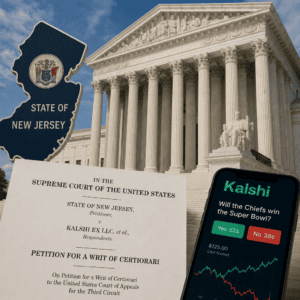 State officials in New Jersey on Wednesday petitioned the U.S. Supreme Court to resolve an escalating jurisdictional conflict regarding whether state gaming authorities or federal agencies oversee sports-related prediction markets. The filing challenges an appellate decision involving prediction platform Kalshi EX LLC and asks the high court to clarify whether federal commodities law preempts state sports-gambling enforcement. The petition arrives at a critical juncture for financial derivatives exchanges and gaming operators, following divergent rulings from federal appeals courts.
Federal Circuit Split Triggers High Court Review
The central legal debate concerns whether event-based sports contracts offered on exchanges registered with the Commodity Futures Trading Commission (CFTC) constitute federally regulated swaps or state-regulated gambling.
The regulatory landscape reached an impasse due to conflicting appellate rulings:
-
Third Circuit Decision: In April, the U.S. Court of Appeals for the Third Circuit ruled 2–1 in favor of Kalshi, determining that the Commodity Exchange Act and the Dodd-Frank Act likely preempt New Jersey gaming regulations, granting exclusive oversight to the CFTC.
-
Ninth Circuit Decision: Conversely, the U.S. Court of Appeals for the Ninth Circuit ruled against Kalshi in a parallel dispute with Nevada regulators, concluding that federal commodities law does not prevent state authorities from enforcing licensing requirements on sports-related contracts.
This explicit split between federal circuits significantly increases the likelihood that the Supreme Court will take up the matter to establish uniform statutory interpretation across jurisdictions.
Arguments on Preemption and State Authority
State regulators contend that permitting financial exchanges to offer sports-event contracts without state oversight undermines statutory frameworks designed to protect consumers, prevent underage wagering, and generate state tax revenues.
“Companies like Kalshi claim to offer legal sports betting in all 50 States, but they refuse to follow the gambling laws of any State,” said New Jersey Attorney General Jennifer Davenport in an official statement. “These companies have no right to offer their sports bets without following state law, which is why dozens of States across the ideological spectrum have opposed them. […] We’re calling on the Supreme Court to resolve this issue and recognize that Congress did not silently make the sports-betting industry immune from state law.”
Conversely, industry proponents and prediction market platforms maintain that event contracts are nationwide financial instruments governed strictly by the CFTC. They argue that subjecting a federally regulated exchange to fifty individual state jurisdictions would create regulatory fragmentation that impedes financial innovation and market efficiency.
Addressing the petition, Kalshi spokesperson Dani Lever stated that the company remains confident in the lower courts’ rulings, adding that an exchange could not operate effectively if “regulated by 50 different regulators.”