



Tribal Nations Seek Federal Injunction to Halt Kalshi Operations on Sovereign Lands



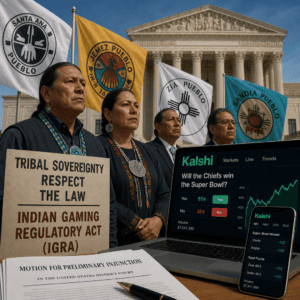 A coalition of Native American tribes has urged a federal court to issue an immediate preliminary injunction prohibiting prediction market operator Kalshi from offering sports-related event contracts within tribal boundaries. The legal challenge, led by four tribal nations in New Mexico, contends that the platform’s digital wagering products bypass the Indian Gaming Regulatory Act (IGRA) and violate longstanding tribal-state gaming compacts. By permitting users located on reservation land to trade contracts tied to athletic competitions, the plaintiffs argue, Kalshi is conducting unauthorized Class III gaming that encroaches upon tribal sovereignty and impairs tribal government revenues.
Allegations of Regulatory Circumvention
The dispute, pending before U.S. District Judge Margaret Strickland, involves the Mescalero Apache Tribe alongside the Pojoaque, Sandia, and Isleta Pueblos. In their filings, the tribes maintain that Kalshi’s event contracts constitute sports betting under federal and state definitions. Under existing tribal-state gaming compacts, legal sports wagering in New Mexico is strictly limited to in-person operations at tribally owned facilities and is restricted to patrons aged 21 and older.
According to the plaintiffs, Kalshi allows individuals aged 18 and older to access its markets and execute wagers directly from tribal lands without tribal authorization or regulatory oversight. The tribes argue that this activity causes irreparable harm by eroding the exclusivity guaranteed under their compacts, which directly fund education, healthcare, and infrastructure. Consequently, the plaintiffs have requested that the court order Kalshi to immediately implement geofencing technology to block access to its exchange within tribal borders.
Kalshi’s Defense and the Federal Preemption Argument
Kalshi has pushed back against the motion, asserting that its platform operates fully within federal law as a designated contract market under the Commodity Exchange Act (CEA). Regulated by the Commodity Futures Trading Commission (CFTC), the New York-based exchange maintains that its sports-event offerings are federally overseen financial derivatives, rather than conventional gaming or gambling products.
In its defense, Kalshi contends that the CEA grants the CFTC exclusive jurisdiction over designated contract markets, thereby preempting state and tribal gambling regulations. The company also argues that tribal regulatory authority does not extend to an out-of-state internet platform operated by non-tribal entities, and that the tribes cannot enforce their state compact provisions against an entity that was never a party to those agreements. From this perspective, subjecting federally approved financial markets to varying tribal boundaries would create an unworkable and fragmented national regulatory environment.
Wider Industry Impact and Legal Precedents
The New Mexico proceedings represent the latest front in an expanding legal debate over the boundaries between financial market innovation and tribal gaming sovereignty. Similar challenges have surfaced in other jurisdictions. In Wisconsin, the Ho-Chunk Nation filed a comparable lawsuit, where a federal judge recognized the tribe’s standing under IGRA but denied a preliminary injunction on the grounds that the tribe had not yet demonstrated sufficient economic harm. In California, three gaming tribes appealed a district court decision to the U.S. Court of Appeals for the Ninth Circuit after a federal judge declined to mandate geofencing on their reservations.
Federal appellate courts nationwide remain divided over the broader issue of whether the Commodity Exchange Act preempts state-level gambling enforcement against event markets. While some decisions have recognized the CFTC’s expansive jurisdiction, others – such as recent rulings in the Ninth Circuit – have concluded that sports-related contracts do not qualify as exempt swaps and remain subject to local gaming oversight.