



CFTC Sues Louisiana Over Prediction Market Ban



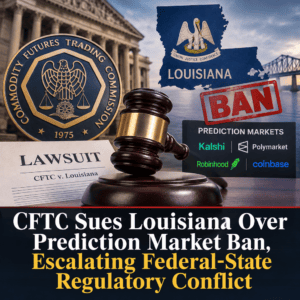 The Commodity Futures Trading Commission (CFTC) has filed a lawsuit against the state of Louisiana, alleging that the state unlawfully applied its gambling laws to federally regulated event contracts. The federal action is a direct response to a Louisiana court order that temporarily barred a broad group of prediction market operators – including Kalshi, Polymarket, Robinhood, and Coinbase – from offering event contracts to Louisiana residents. Louisiana is now the twelfth state the agency has sued in its effort to preserve what it describes as its exclusive jurisdiction over derivatives markets.
Background of the Dispute
The conflict began after Louisiana’s Attorney General filed a state court action accusing prediction market platforms of operating unlawful gambling operations within the state. On November 12, a Louisiana judge granted a temporary restraining order affecting more than 30 companies tied to CFTC-regulated derivatives trading. According to the CFTC, the order was issued without notice or a hearing for the affected entities.
The state-level proceedings followed separate federal lawsuits filed by prediction market operators against Louisiana officials in October, in which the operators asserted that federal law preempts state gambling regulation of event contracts. At least one of those actions sought to block the state from shutting down platforms offering contracts on economic, political, and other outcomes.
The CFTC’s complaint seeks to void the Louisiana court order and prevent the state from barring CFTC-regulated exchanges and associated entities from offering event contracts. The federal action was reportedly joined by the Department of Justice, underscoring the significance the federal government has placed on the dispute.
The Core Legal Question
At the center of the litigation is the scope of the Commodity Exchange Act, under which Congress granted the CFTC exclusive jurisdiction over derivatives markets. The CFTC maintains that event contracts traded on federally designated contract markets fall squarely within that jurisdiction, and that states cannot impose their own licensing or prohibition regimes on such products.
State officials and gambling regulators, by contrast, argue that prediction markets function in substance as wagering on outcomes – particularly sports-related contracts – and therefore fall within traditional state police powers over gambling. The Louisiana Gaming Control Board has previously issued advisory notices to state sports wagering operators regarding prediction market activity, reflecting the state’s position that these products compete directly with its regulated gambling market.