



Gambling Mogul Escalante Departs Court Amid Renewed Bail Hearings

Laurence Escalante
Laurence Escalante, the billionaire founder of online gaming company Virtual Gaming Worlds (VGW), made a brief appearance in the Perth Magistrates Court before being escorted from the premises by private security amid a media presence. The appearance forms part of ongoing proceedings related to domestic violence and drug-related charges, with the businessman seeking variations to his bail conditions.
Background to the Proceedings
Escalante was first arrested and charged in early 2026 in connection with the alleged assault of his former partner. According to reporting by Forbes, Western Australia Police alleged he entered the home of his ex-partner, assaulted her and took items including jewelry. Initial charges included aggravated assault, criminal damage and aggravated home burglary.
He was subsequently granted bail under strict conditions. These were reported to include daily reporting requirements, a 9pm curfew, surrender of his passport, the posting of a $100,000 bond and the wearing of an ankle bracelet. The 44-year-old has stated through his representatives that he intends to defend the allegations, which have not been tested in court.
The case has since expanded. Additional charges, including drug offences, were laid in subsequent hearings, bringing the total number of charges to 17, according to The Australian and the Australian Financial Review.
The most recent hearing centred on amendments to Escalante’s bail conditions. Earlier variations reportedly included changes to a restriction preventing him from being within 500 metres of a point of international departure, a condition that had practical implications for his day-to-day movement. Later in the year, his bail was varied to permit travel, including visits overseas, a development that attracted media attention given the seriousness of the charges.
The legal proceedings have had significant consequences for his business interests. Escalante resigned as chief executive and chairman of VGW, the online casino empire he established in 2010, following the laying of charges. Separately, he has been reported to face a $60 million legal dispute, adding commercial pressure to his personal legal challenges.
Brazil’s Supreme Court Hears Clashing Arguments Over Betting Ban
 Brazil’s Supreme Federal Court (STF) convened a public hearing on 3 November to examine competing constitutional arguments over Provisional Measure 1,394/2026, the government measure that prohibits fixed-odds betting nationwide. The hearing, called by Justice Luiz Fux and held in the Second Chamber, brought together representatives of the federal government, the betting industry, sports organizations, and civil society groups, each presenting positions on whether the ban should stand.
The Measure Under Review
Provisional Measure 1,394, published on 25 September 2026, prohibits the operation, offering, intermediation, and advertising of fixed-odds betting across Brazil. It also ends authorizations previously granted under Law 14,790/2023, the framework that had established a regulated market for sports betting and iGaming, and blocks the issuance of new licenses. The measure followed a broad political debate in which a Senate public consultation recorded roughly 480,000 responses, with approximately 85.6% expressing support for a ban.
The measure has faced multiple constitutional challenges. Flamengo, one of Brazil’s most prominent football clubs, petitioned the STF for an urgent suspension of its effects, arguing that the rule threatens sponsorship revenues. The club has warned of an estimated $84 million financial impact and associated job losses should the ban remain in force.
The Arguments Before the Court
The Attorney General’s Office (AGU) defended the measure, reversing its earlier position and asking the Court to declare unconstitutional the core provisions of the laws that had legalized betting, namely Law 13,756/2018 and Law 14,790/2023. The government’s argument rests on concerns about gambling-related social harm and consumer protection.
Industry representatives countered that a regulated market, rather than a prohibition, offers more effective safeguards. Speakers warned that shutting down licensed operators risks driving consumers toward illegal, unregulated gambling, undermining tax collection, employment, and player protections. The sector argued that the regulatory framework had been operational for two years and that prohibition would erase those gains rather than address underlying harm.
Justice Fux, who scheduled the hearing, indicated during proceedings that he viewed the negative effects of online betting as a matter the Court had already examined closely, signaling potential sympathy for the government’s position while remaining open to further arguments.
The hearing comes against a separate but related judicial backdrop. In August, the STF suspended a judgment on the validity of the 1941 Criminal Misdemeanours Law, which criminalizes games of chance, after Justice Fux voted to uphold the prohibition and Justice Flávio Dino called for the matter to be paused. That case, which affects more than 2,700 similar proceedings, may ultimately be considered alongside the challenges to the provisional measure.
In the legislative arena, lawmakers filed 97 amendments to the provisional measure, some seeking to restore a regulated market and others to redirect confiscated proceeds from illegal betting toward health services, addiction treatment, and sport.
Outlook
The Court’s eventual ruling will determine the future of one of Latin America’s most significant regulated betting markets. Operators, sponsors, and investors now await a decision that will clarify whether Brazil reverts to prohibition or reaffirms the licensing framework established in 2023. Until the STF issues its judgment, the sector remains in a state of legal uncertainty, with substantial revenue, employment, and tax implications on either side of the outcome.
William Hill Broadens Nevada Sportsbook Network Through Terrible’s Partnership
 William Hill, the sportsbook subsidiary of Caesars Entertainment, is positioned to expand its retail sports betting footprint across Nevada after state regulators advanced licensing for three additional Terrible’s casino locations. The Nevada Gaming Control Board unanimously approved the licenses during its November proceedings, with the matter now set to proceed to the Nevada Gaming Commission, which is expected to consider the approvals at its November 19 meeting.
Details of the Expansion
The proposed agreement would add William Hill race and sports book operations at three Terrible’s properties across the state:
-
Terrible’s Casino in Indian Springs, located along US Highway 95 north of Las Vegas
-
Terrible’s Casino in Carlin, in northeastern Nevada
-
Terrible’s Searchlight Casino in Searchlight, south of the Las Vegas Valley
If approved, the additions would push William Hill’s Nevada sportsbook count above 110 locations, reinforcing its position as the state’s largest retail sportsbook operator. The company already operates books at a broad range of Nevada properties, from small rural casinos to major Las Vegas Strip resorts.
The Nevada Gaming Control Board’s unanimous recommendation signals regulatory comfort with the arrangement, which follows a well-established model in the Nevada market: casino operators partner with licensed book operators rather than running race and sports pools in-house. The Gaming Commission’s final approval is the remaining step before the books can open under the William Hill brand.
The licensing agenda also included other sportsbook applicants, reflecting continued, measured growth in Nevada’s retail sports betting sector even as national attention remains focused on online expansion in other states.
The partnership builds on a long history between the two companies. William Hill and Affinity Gaming, the parent company associated with the Terrible’s brand, previously entered into a long-term sports betting agreement that included capital investments in race and sports books across Affinity’s Nevada properties. The latest proposal extends and deepens that relationship across a wider portfolio of locations.
The Caesars connection is also relevant. Caesars Entertainment acquired William Hill in 2021 for approximately £2.9 billion, and the William Hill brand has since operated as the company’s retail sportsbook vehicle in Nevada, where Caesars Sportsbook branding is used elsewhere.
Melco Resorts Reports Near-Breakeven Third-Quarter Net Income
 Melco Resorts & Entertainment Ltd has reported net income of just US$34,000 for the third quarter, a sharp decline that reflects softened operating conditions across its two principal markets, Macau and Manila. The result stands in contrast to the stronger earnings recorded in the same period a year earlier, when the company benefited from more favorable gaming volumes.
Total operating revenues for the quarter reached US$1.17 billion, representing a decrease of approximately 10 percent from the US$1.31 billion reported in the prior-year period. The reduction reflects lower gaming revenues in both Macau, where the company operates City of Dreams, Studio City, and Altira, and the Philippines, where it operates City of Dreams Manila.
Adjusted property EBITDA for the quarter was approximately US$288 million, according to figures disclosed alongside the earnings release. Management noted that operating expenses in Macau came in below guidance, a factor that partially cushioned the impact of the softer revenue environment.
The quarter’s performance arrives amid intensifying competition in Macau’s gaming sector, where concessionaires have continued to invest heavily in non-gaming amenities and promotional activity to capture market share. Softer high-end and mass-market volumes have weighed on operators across the market, with industry-wide gross gaming revenue growth moderating compared with the immediate post-pandemic recovery period.
In Manila, the company faces its own set of headwinds, including competition within the Entertainment City precinct and evolving regulatory conditions in the Philippine gaming sector.
Despite the headline decline, the company’s earnings per share of US$0.02 exceeded the consensus estimate of a modest loss, indicating that cost discipline and non-operating items helped the group avoid a quarterly deficit. Management also indicated that October performance outpaced the broader market, suggesting a firmer start to the fourth quarter.
Kalshi Midterm Election Markets Generate $2.5 Billion in Trading Volume
 Kalshi reported more than $2.5 billion in total notional trading volume across its election markets during the 2026 U.S. midterm cycle, nearly doubling the $1.3 billion recorded during the 2024 presidential election. The figures, released on November 4, 2026, underscore the rapid expansion of regulated prediction markets as a venue for political forecasting and signal a structural shift in how market participants price electoral outcomes.
Record Volume Across Election Contracts
The $2.5 billion figure represents aggregate trading across Kalshi’s full suite of midterm-related contracts, including markets on House and Senate control, individual races, and state-level outcomes. All 435 House seats and 35 Senate seats were available for trading on the platform.
The growth is notable given the historical pattern of midterm cycles attracting less speculative interest than presidential elections. Volume on election-related markets had been largely flat through much of the two-year period between national votes, making the late-cycle surge particularly pronounced.
Competitor platforms also saw substantial activity. Polymarket reportedly generated roughly $600 million across more than 7,000 election-related markets during the cycle, though its figures include pre-election activity on platforms operating under different regulatory frameworks.
Accuracy and Speed of Results
Kalshi stated that its traders correctly called approximately 98 percent of the 2026 midterm races, and that contract pricing signaled outcomes on House and Senate control hours before official network projections. The company attributed the speed to continuous, real-money pricing that updates as results are reported.
However, the cycle was not without misses. Reporting noted at least one high-profile race in which a candidate’s victory defied market odds, a reminder that prediction markets remain probabilistic instruments rather than guarantees.
Industry observers point to several factors behind the volume increase, including significant advertising spending by prediction market operators, content partnerships with news organizations and sports leagues, and broader mainstream acceptance of event contracts as a financial product class.
Kalshi operates as a regulated exchange under oversight of the Commodity Futures Trading Commission (CFTC), a distinction that has shaped its positioning relative to platforms operating in regulatory gray areas. The company’s expansion into political markets has coincided with broader growth in event contracts covering economics, weather, and cultural outcomes.
Flutter Records $1.15bn Q3 Net Loss, Cuts Full-Year Guidance
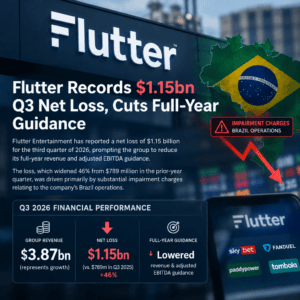 Flutter Entertainment has reported a net loss of $1.15 billion for the third quarter of 2026, prompting the group to reduce its full-year revenue and adjusted EBITDA guidance. The loss, which widened 46% from $789 million in the prior-year quarter, was driven primarily by substantial impairment charges relating to the company’s Brazil operations.
Financial Performance
Group revenue for the quarter reached $3.87 billion, representing year-over-year growth of approximately 2.1%. However, the figure fell short of analyst consensus expectations, and Flutter shares declined following the release.
The headline net loss was largely attributable to $873 million in impairment charges recognized in connection with Brazil, where Flutter holds a 56% ownership stake. Of the post-tax impairment, $537 million was attributable to Flutter. The company also recorded a $105 million increase in legal loss provisions during the period.
The performance of the company’s US segment was a further area of concern, with FanDuel’s US adjusted EBITDA falling 94% year over year. In contrast, FanDuel retained its leading position in both online sports betting and related verticals in the US market, providing a partial offset to the broader pressures.
In response to the quarter’s results, Flutter lowered its full-year 2026 guidance:
-
Group revenue: reduced by $300 million at the midpoint to $17.61 billion, below the consensus estimate of $17.79 billion
-
Group adjusted EBITDA: reduced by $160 million at the midpoint to $2.495 billion
The reductions reflect revised expectations across several markets, with management pointing to softer sports results and the anticipated impact of the Brazil exit on the group’s financial trajectory.
In a letter to shareholders, Flutter CEO Dan Taylor addressed the quarter’s outcome and the company’s response. While the impairment charges reflect a reassessment of the Brazilian business, management signaled that the company intends to reallocate resources toward markets and products expected to deliver higher returns, consistent with recent capital-discipline measures elsewhere in the portfolio.
Light & Wonder Posts Modest Q3 Revenue
 Light & Wonder reported third-quarter 2026 consolidated revenue of $824 million, a 2% decline year-over-year, even as net income rose 17% to $133 million. The results, released on November 4, 2026, reflect a familiar pattern for the gaming supplier: continued strength in its iGaming segment and core gaming operations, weighed down by ongoing weakness in the social casino free-to-play market through its SciPlay division.
Segment Performance
The iGaming segment once again delivered double-digit growth, with revenue increasing 13% during the quarter. The performance continues a consistent trend throughout 2026, following 18% revenue growth in the first quarter and 14% growth in the second quarter, driven largely by momentum in the United States market.
By contrast, SciPlay revenue declined 12% to $173 million, which the company attributed to continued softness in the broader social casino free-to-play market. The decline was partially offset by growth in direct-to-consumer revenue, which reached $53 million, or 31% of total SciPlay revenue for the quarter – an expanded contribution compared with 29% in the prior quarter and approximately 18% a year earlier.
Within the core Gaming segment, machine sales increased 5% to $199 million, supporting profitability even as consolidated revenue slipped.
Despite the modest top-line contraction, the company’s profitability improved. Net income of $133 million compared favorably with $114 million in the prior-year period, and earnings and cash flow both grew as recurring gaming revenue expanded. The results suggest that favorable product mix and growth in higher-margin recurring revenue streams are helping to buffer the company against softness in specific segments.
Year-to-date consolidated revenue grew 1% to $2,440 million, indicating the business remains broadly stable despite quarterly volatility.
Light & Wonder reaffirmed its outlook for mid to high single-digit consolidated AEBITDA growth for the full year 2026, with earnings expected to be weighted toward the latter part of the year. The reaffirmation signals management confidence that the iGaming trajectory and gaming operations can carry the company through the continued free-to-play headwinds.
A Mixed but Manageable Picture
For industry professionals, the quarter underscores two divergent dynamics in the gaming sector. Digital real-money iGaming continues to expand at a healthy clip in regulated U.S. markets, rewarding suppliers with diversified content portfolios. Meanwhile, the social casino free-to-play market remains under sustained pressure, with SciPlay’s declining revenue partially cushioned – but not fully offset – by its growing direct-to-consumer strategy.
The company’s ability to grow net income and cash flow despite a revenue decline points to disciplined cost management and a favorable revenue mix. However, the persistence of SciPlay weakness will remain a key variable as the company works toward its full-year guidance.
With one quarter remaining in its fiscal year, Light & Wonder enters the final stretch with momentum in its highest-growth segment and a reaffirmed earnings outlook – a position that many peers in the segment would consider resilient, if not entirely unqualified.
Tuberville’s Alabama Governor Win Keeps Gambling Expansion Prospects Alive

Alabama State Senate
U.S. Senator Tommy Tuberville (R-Auburn) won Alabama’s Mid-Term election, a result that carries meaningful implications for the future of sports betting, casino gaming, and a state lottery in Alabama. While the incoming governor’s victory does not legalize any form of expanded gaming on its own, his stated willingness to support a comprehensive gambling package – subject to voter approval – could shift the political dynamics that have repeatedly stalled such efforts in Montgomery.
A Governor Open to Expansion – On His Terms
Tuberville made his position clear in the weeks before the election. He stated that if elected, he would not stand in the way of a legislative push to legalize gambling in Alabama. However, he emphasized that any expansion should come as a complete, well-constructed package placed before voters as a constitutional amendment, rather than a piecemeal approach.
“I think the governor’s role is to make sure we do it the right way,” Tuberville said ahead of the election, adding that Alabamians should have the final say on the matter. He also indicated he was prepared to sign off on a lottery if the legislature advanced one and voters approved it.
That position matters because Alabama’s constitution prohibits most forms of gambling. Any expansion – whether a lottery, commercial casinos, or regulated sports betting – requires a constitutional amendment passed by the legislature and ratified by voters. The governor’s signature and disposition toward such legislation therefore carry significant weight.
A History of Legislative Stalls
The path to expanded gaming in Alabama has been marked by repeated near-misses. In 2024, the Alabama House passed a comprehensive package that included a state lottery, up to ten casinos with table games and slot machines, and legal sports betting. The Senate, however, stripped the legislation down to a lottery-only measure, and the broader package ultimately failed.
The 2026 legislative session offered little progress. Key lawmakers indicated that gambling bills received no serious consideration, with some observers describing the 2025 failures as having set the issue back considerably. During that same period, legislation was introduced to block new gaming-related local constitutional amendments, underscoring the divisions that persist within the legislature.
The election result arrives as Alabama residents increasingly access gaming options outside state regulation. Sports betting remains illegal in Alabama, but prediction markets have emerged as a workaround, offering residents exposure to event-based contracts without state-authorized sportsbooks. This dynamic has intensified calls from within the state to formalize a legal framework and capture revenue currently flowing elsewhere.
Public advocacy has also grown more prominent. Former NBA star Charles Barkley, an Alabama native, publicly urged lawmakers in October 2026 to legalize sports betting and establish a lottery, stating, “We need sports gambling in Alabama.”
Nebraska Voters Oppose Online Sports Betting Initiatives
 Nebraska voters have declined to legalize online sports betting, rejecting both Initiative 440 and Initiative 441 in the November 3, 2026 Mid-Term elections. The paired measures – a constitutional amendment and a companion statutory measure – would have authorized mobile and online sports wagering statewide and empowered the Nebraska Racing and Gaming Commission to regulate operators. The outcome preserves the state’s existing framework, in which casino gaming is permitted at licensed racetrack facilities but digital sports wagering remains prohibited.
The Results
Early returns showed consistent opposition to both measures. As of midnight following the election, Initiative 440 had drawn 239,331 votes in favor and 285,520 against, while Initiative 441 stood at 241,599 votes in favor and 283,159 against. Initiative 440 would have amended the Nebraska Constitution to allow the Legislature to enact laws governing online sports wagering; Initiative 441 would have formally authorized the practice and tasked the state gaming commission with adopting rules for operators and wagers.
Under the proposed framework, a majority of tax proceeds – reported at 70 percent – would have been directed toward property tax relief, a central argument of the support campaign. Supporters estimated the measures could have generated more than $166 million in designated relief over time, though opponents characterized the projected benefit as a negligible fraction of the state’s overall property tax burden.
A Heavily Funded Campaign Falls Short
The campaign in support of the measures, organized under the committee Tax Relief Nebraska, was financed substantially by national sportsbook operators. DraftKings and FanDuel each contributed approximately $10.4 million, with additional backing from BetMGM and Fanatics, bringing the committee’s total fundraising to roughly $14.65 million.
Opposition, while outspent, proved effective. Save Nebraska Sports registered as the primary opposing campaign, and it was joined by organizations including the Nebraska Family Alliance and the Nebraska Catholic Conference, which urged voters to reject the measures on the grounds that online wagering would expand problem gambling and increase accessibility, particularly among younger residents. Notably, the Winnebago Tribe of Nebraska voiced support for the initiatives, illustrating that the debate did not divide cleanly along predictable lines.
Texas Mid-Term Election Results Reshape Outlook for Gambling Expansion
 Democrats Gina Hinojosa and Vikki Goodwin secured victories in Texas’s November 3, 2026 statewide elections, with Hinojosa defeating Republican Governor Greg Abbott and Goodwin unseating longtime Lieutenant Governor Dan Patrick. The results end more than three decades of Republican control of the governor’s office and introduce a new variable into the long-stalled debate over legalizing casinos and sports betting in the nation’s second-most-populous state.
Hinojosa, a Democratic state representative from Austin, won the gubernatorial race with approximately 52.8% of the vote to Abbott’s 45.8%, according to live tallies. Abbott, who had served as governor since 2015, conceded the race on election night. Goodwin, also a state representative from the Austin area, declared victory over Patrick in the lieutenant governor’s contest and becomes the first Democratic lieutenant governor in Texas in 27 years.
The dual outcome carries particular significance for gaming industry stakeholders because the two offices sit at the center of Texas’s legislative process. In Texas, gambling expansion requires a constitutional amendment, meaning any casino or sports betting proposal must pass both chambers of the Legislature by a two-thirds supermajority before reaching voters.
Shifting Dynamics in the Senate
The lieutenant governor wields substantial influence over the Senate, controlling committee assignments and the flow of legislation. Patrick had been a consistent opponent of casino and sports betting measures during his tenure. Goodwin, by contrast, has publicly stated that she supports allowing Texas voters to decide on legalized casinos and online sports betting through a statewide ballot measure, framing the issue as one of personal freedom.
Goodwin’s victory does not by itself guarantee passage of any expansion measure. A two-thirds vote in the Senate remains a high threshold, and the chamber’s partisan composition will still constrain which proposals can advance. However, the change in leadership removes what industry observers have long identified as the primary institutional barrier to a floor vote.
The Governor’s Position
The gubernatorial outcome presents a more complicated picture for expansion advocates. Hinojosa opposed House Joint Resolution 102, the 2023 sports betting constitutional amendment, and has not released a detailed gambling platform. In past legislative sessions, she raised concerns that proposed casino legislation did not include sufficient provisions for hiring companies owned by women and minorities.
The governor’s office in Texas carries limited direct authority over the constitutional amendment process, though the occupant shapes the policy agenda and can influence negotiations. Abbott, for his part, had signaled openness to legalized online sports betting in early 2025 but never championed the issue legislatively.
What Comes Next
The Texas Legislature convenes in regular session in January 2027, the first opportunity for the newly constituted government to consider gambling legislation. The state remains one of the largest in the country with no legal sports wagering and no Las Vegas-style commercial casinos, making it a frequently cited long-term prize for operators and sportsbooks.
For now, the election results change the political calculus without altering the legal landscape. The combination of a receptive Senate presiding officer and a governor whose position remains undefined creates an opening for renewed debate, but passage still depends on assembling supermajorities in both chambers and, ultimately, voter approval. Industry participants should treat the 2027 session as the next meaningful checkpoint, while recognizing that structural requirements in the Texas Constitution leave the timeline for any expansion uncertain.