 Brazil’s Supreme Federal Court (STF) convened a public hearing on 3 November to examine competing constitutional arguments over Provisional Measure 1,394/2026, the government measure that prohibits fixed-odds betting nationwide. The hearing, called by Justice Luiz Fux and held in the Second Chamber, brought together representatives of the federal government, the betting industry, sports organizations, and civil society groups, each presenting positions on whether the ban should stand.
The Measure Under Review
Provisional Measure 1,394, published on 25 September 2026, prohibits the operation, offering, intermediation, and advertising of fixed-odds betting across Brazil. It also ends authorizations previously granted under Law 14,790/2023, the framework that had established a regulated market for sports betting and iGaming, and blocks the issuance of new licenses. The measure followed a broad political debate in which a Senate public consultation recorded roughly 480,000 responses, with approximately 85.6% expressing support for a ban.
The measure has faced multiple constitutional challenges. Flamengo, one of Brazil’s most prominent football clubs, petitioned the STF for an urgent suspension of its effects, arguing that the rule threatens sponsorship revenues. The club has warned of an estimated $84 million financial impact and associated job losses should the ban remain in force.
The Arguments Before the Court
The Attorney General’s Office (AGU) defended the measure, reversing its earlier position and asking the Court to declare unconstitutional the core provisions of the laws that had legalized betting, namely Law 13,756/2018 and Law 14,790/2023. The government’s argument rests on concerns about gambling-related social harm and consumer protection.
Industry representatives countered that a regulated market, rather than a prohibition, offers more effective safeguards. Speakers warned that shutting down licensed operators risks driving consumers toward illegal, unregulated gambling, undermining tax collection, employment, and player protections. The sector argued that the regulatory framework had been operational for two years and that prohibition would erase those gains rather than address underlying harm.
Justice Fux, who scheduled the hearing, indicated during proceedings that he viewed the negative effects of online betting as a matter the Court had already examined closely, signaling potential sympathy for the government’s position while remaining open to further arguments.
The hearing comes against a separate but related judicial backdrop. In August, the STF suspended a judgment on the validity of the 1941 Criminal Misdemeanours Law, which criminalizes games of chance, after Justice Fux voted to uphold the prohibition and Justice Flávio Dino called for the matter to be paused. That case, which affects more than 2,700 similar proceedings, may ultimately be considered alongside the challenges to the provisional measure.
In the legislative arena, lawmakers filed 97 amendments to the provisional measure, some seeking to restore a regulated market and others to redirect confiscated proceeds from illegal betting toward health services, addiction treatment, and sport.
Outlook
The Court’s eventual ruling will determine the future of one of Latin America’s most significant regulated betting markets. Operators, sponsors, and investors now await a decision that will clarify whether Brazil reverts to prohibition or reaffirms the licensing framework established in 2023. Until the STF issues its judgment, the sector remains in a state of legal uncertainty, with substantial revenue, employment, and tax implications on either side of the outcome.




 William Hill, the sportsbook subsidiary of Caesars Entertainment, is positioned to expand its retail sports betting footprint across Nevada after state regulators advanced licensing for three additional Terrible’s casino locations. The Nevada Gaming Control Board unanimously approved the licenses during its November proceedings, with the matter now set to proceed to the Nevada Gaming Commission, which is expected to consider the approvals at its November 19 meeting.
 Melco Resorts & Entertainment Ltd has reported net income of just US$34,000 for the third quarter, a sharp decline that reflects softened operating conditions across its two principal markets, Macau and Manila. The result stands in contrast to the stronger earnings recorded in the same period a year earlier, when the company benefited from more favorable gaming volumes.
 Kalshi reported more than $2.5 billion in total notional trading volume across its election markets during the 2026 U.S. midterm cycle, nearly doubling the $1.3 billion recorded during the 2024 presidential election. The figures, released on November 4, 2026, underscore the rapid expansion of regulated prediction markets as a venue for political forecasting and signal a structural shift in how market participants price electoral outcomes.
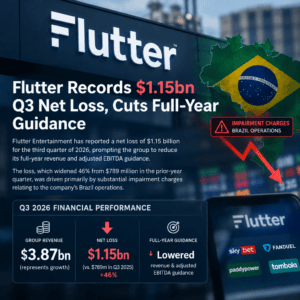 Flutter Entertainment has reported a net loss of $1.15 billion for the third quarter of 2026, prompting the group to reduce its full-year revenue and adjusted EBITDA guidance. The loss, which widened 46% from $789 million in the prior-year quarter, was driven primarily by substantial impairment charges relating to the company’s Brazil operations.
 Light & Wonder reported third-quarter 2026 consolidated revenue of $824 million, a 2% decline year-over-year, even as net income rose 17% to $133 million. The results, released on November 4, 2026, reflect a familiar pattern for the gaming supplier: continued strength in its iGaming segment and core gaming operations, weighed down by ongoing weakness in the social casino free-to-play market through its SciPlay division.

 Nebraska voters have declined to legalize online sports betting, rejecting both Initiative 440 and Initiative 441 in the November 3, 2026 Mid-Term elections. The paired measures – a constitutional amendment and a companion statutory measure – would have authorized mobile and online sports wagering statewide and empowered the Nebraska Racing and Gaming Commission to regulate operators. The outcome preserves the state’s existing framework, in which casino gaming is permitted at licensed racetrack facilities but digital sports wagering remains prohibited.
 Democrats Gina Hinojosa and Vikki Goodwin secured victories in Texas’s November 3, 2026 statewide elections, with Hinojosa defeating Republican Governor Greg Abbott and Goodwin unseating longtime Lieutenant Governor Dan Patrick. The results end more than three decades of Republican control of the governor’s office and introduce a new variable into the long-stalled debate over legalizing casinos and sports betting in the nation’s second-most-populous state.