



KSA Chair Urges Cross-Border Collaboration as Dutch Illegal Market Outpaces Legal Channel



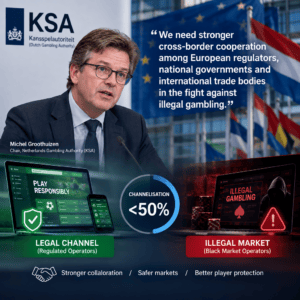 The Chair of the Netherlands Gambling Authority (KSA) has called for stronger cross-border cooperation among European regulators, national governments, and international trade bodies in the fight against illegal gambling. Michel Groothuizen’s appeal comes as channelisation in the Dutch market falls below 50%, signalling that the country’s regulated operators are now competing against a black market of comparable – if not greater – scale.
A Market Under Pressure
The Netherlands legalised online gambling in October 2021 with the ambition of channelling the majority of players into the licensed market. According to the KSA’s annual report, channelisation fell to 49% in 2025, meaning the illegal sector overtook the legal market for the first time. This development has intensified scrutiny of the regulatory framework and prompted debate in the Dutch House of Representatives, whose gambling committee has called for mechanisms allowing illegal gambling websites to be blocked more rapidly.
Groothuizen has argued that the debate surrounding the black market frequently fails to acknowledge its international dimension. The KSA has warned that the Netherlands alone cannot tackle a black market dominated by what it describes as a “global network of criminal organisations.”
The Case for International Coordination
The regulator’s position is that disrupting illegal operators requires intervention across multiple layers of their infrastructure, including payments, hosting, and distribution – most of which extend beyond Dutch jurisdiction. Greater international cooperation is therefore needed to cut off the financial and technical channels that sustain offshore operations.
The KSA has previously pursued bilateral cooperation through memoranda of understanding with regulators such as the Swedish Gambling Authority and France’s Autorité Nationale des Jeux (ANJ). These agreements provide for mutual assistance in obtaining betting, gaming, and transactional data where platform architecture spans multiple jurisdictions.
Enforcement at the national level continues alongside these efforts. In March 2026, the KSA issued a record fine against offshore operators illegally targeting Dutch players, with Groothuizen noting that penalties are calculated on the basis of estimated illegal turnover.
The KSA is not alone in its position. The European Gaming and Betting Association (EGBA) has repeatedly urged regulatory bodies to work together and, in March 2026, called on the European Commission to address rising online fraud through strengthened coordination and cross-border cooperation. More recently, the EGBA filed a complaint with the Bank of Lithuania against payments firm Walletto, alleging the miscoding of transactions linked to illegal online gambling operators – an indication that the payments chain is emerging as a key enforcement frontier.