



Lords Committee Calls for Comprehensive Ban on Gambling Advertising in the UK



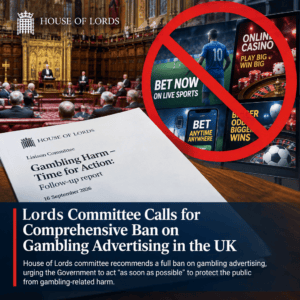 A House of Lords committee has recommended a comprehensive ban on gambling advertising in the United Kingdom, setting the stage for a renewed confrontation between regulators, parliamentarians, and the betting industry. The recommendation, published on 16 September 2026 in the Liaison Committee’s report “Gambling Harm – Time for Action: Follow-up report,” urges the Government to implement the prohibition “as soon as is practicable.”
The report follows a one-off evidence session held in June 2026, during which the committee examined the progress made since the original 2020 Select Committee report on the social and economic impact of the gambling industry. Peers heard testimony on the relationship between advertising exposure and gambling-related harm, with particular attention paid to the risks posed to children and young people.
The Committee’s Position
The Liaison Committee’s follow-up inquiry was established to assess whether the recommendations of the original Gambling Industry Committee had been adequately addressed. In May 2025, the committee wrote to the Minister for Museums, Heritage and Gambling at the Department for Culture, Media and Sport, receiving a Government response in July 2025. The latest report indicates that peers remain unconvinced that voluntary and regulatory measures have gone far enough.
Lord Foster of Bath, the Liberal Democrat peer who has long campaigned on gambling reform, has been a prominent figure in the committee’s work. During the June evidence session, he referenced international precedent, noting that Italy operates a total ban on gambling advertising – a comparison frequently cited by reform advocates.
Industry Response
The Betting and Gaming Council (BGC), the standards body for the regulated industry, has pushed back against the findings. Chief Executive Grainne Hurst has described the report as “deeply misguided,” arguing that the industry has made meaningful progress on advertising reform and safer gambling measures. The sector has previously pointed to the whistle-to-whistle ban – voluntary restrictions on gambling advertising during live sports broadcasts before the watershed – and to its funding of research, education, and treatment services as evidence of a functioning self-regulatory framework.
Industry representatives have also cautioned that heavy-handed restrictions on licensed operators could push consumers toward the unlicensed black market, a concern the BGC has raised repeatedly in parliamentary proceedings. Earlier this year, the Council welcomed the Government’s plans, outlined by Gambling Minister Baroness Twycross, to crack down on illegal gambling advertising targeting UK consumers from offshore operators.
A Shifting Policy Landscape
The recommendation arrives amid mounting pressure on the Government to act. In April 2026, the Gambling Reform All-Party Parliamentary Group and Peers for Gambling Reform published a report calling for sweeping crackdowns on advertising to protect children and young people. Separately, researchers have urged the Department for Culture, Media and Sport to extend existing restrictions on sponsorship to licensed operators and online advertising.
The Premier League’s ban on gambling sponsorship on front-of-shirt branding, introduced for the 2026/27 season, has already demonstrated that parts of the sports and betting ecosystem are adjusting to a more restrictive environment.
As with any select committee report, the recommendations are advisory rather than binding, and the Government is not obliged to adopt them. However, the intervention adds to a sustained and growing body of parliamentary opinion favouring statutory restrictions, and it will likely intensify scrutiny of the Government’s position ahead of any future legislation.