



Quebec Election Puts Online Gambling and Prediction Markets on the Campaign Agenda



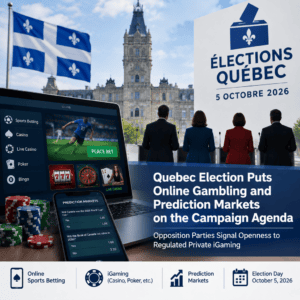 Online sports betting and iGaming have emerged as substantive campaign issues in Quebec’s provincial election, as the Quebec Online Gaming Coalition welcomed commitments from opposition parties to consider regulating private online gaming in the province. With voters heading to the polls on October 5, 2026, the debate marks a potential turning point for a province that has long resisted opening its online gambling market to competition.
On September 10, 2026, the Quebec Online Gaming Coalition announced its support following statements from the Quebec Liberal Party (PLQ) and the Parti Québécois (PQ) indicating a willingness to revisit the province’s approach to private online gaming regulation. According to the Coalition, the commitments were made public through interviews during the campaign period.
A Market in Transition
Quebec currently operates one of the more restrictive models in Canada. Loto-Québec, the provincial gaming monopoly, offers the only legal platform for online gambling in the province through Espacejeux and its Mise-o-jeu sports betting product. Despite this, a substantial volume of Quebec players wager with offshore and grey-market operators, a dynamic the Coalition argues undermines both consumer protections and provincial revenue.
The Coalition has previously stated that debate over gambling advertising volume has stalled progress toward a competitive market in the province, even as other jurisdictions move forward. Alberta launched its regulated iGaming market on July 13, 2026, joining Ontario as the second Canadian province with an open, competitive online gambling framework. Alberta’s model applies a 20% levy on operator gaming revenue.
Prediction Markets Enter the Debate
A distinctive feature of Quebec’s election-cycle discussion is the treatment of prediction markets. The Quebec Liberal Party has gone furthest in articulating a position, proposing that the province’s financial and gambling regulators be tasked with addressing what it describes as a regulatory gap surrounding prediction markets operating in the province. Event-contract trading platforms have expanded rapidly across North America, and their classification – whether as financial instruments or gambling products – remains contested in multiple jurisdictions.
Weighing the Perspectives
Supporters of a regulated competitive market argue it would channel existing player activity into a licensed framework, generating tax revenue, imposing responsible gambling standards, and giving regulators oversight over advertising and player safeguards. The Coalition, which represents industry operators, has positioned reform as a matter of closing the gap between law and consumer behavior.
Opposition voices within the debate remain cautious. Concerns center on gambling-related harm, the density of advertising in an open-market environment, and the impact of competition on Loto-Québec’s revenues, which help fund provincial programs. The governing party’s position on liberalization has been less forthcoming, leaving the extent of post-election change uncertain.