




Kalshi Avoids Restraining Order In New York



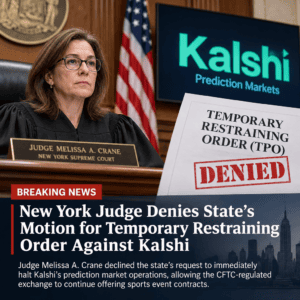 A New York Supreme Court judge has declined the state’s request to immediately halt Kalshi’s prediction market operations, delivering a procedural setback to the state’s effort to shut down what regulators describe as an unlicensed gambling business. Judge Melissa A. Crane denied the motion for a temporary restraining order (TRO), allowing the CFTC-regulated exchange to continue offering sports event contracts to New York users while the broader litigation proceeds.
Background of the Dispute
The ruling follows a lawsuit filed by New York Attorney General Letitia James, who has accused Kalshi of operating an “illegal, unlicensed gambling operation” by offering sports event contracts without authorization from the state. The complaint, announced alongside Governor Kathy Hochul, seeks a court order preventing Kalshi from functioning as an unlicensed gambling business, along with financial penalties.
The matter returned to state court after US District Judge Vernon Broderick in Manhattan granted New York’s request to remand the case, rejecting Kalshi’s attempt to keep the litigation in federal court. That decision represented a significant win for the state, clearing the way for Judge Crane to consider the TRO motion.
Kalshi had warned that a restraining order could effectively cripple the platform, potentially forcing a shutdown not only in New York but across the United States, given the company’s nationwide operations. The denial of the TRO means Kalshi may continue operating while the case is litigated.
The Core Legal Question
At the center of the dispute is whether Kalshi’s sports event contracts constitute gambling under New York law or financial instruments subject to federal oversight. Kalshi maintains that its contracts are “swaps” regulated by the Commodity Futures Trading Commission (CFTC), and that federal law preempts state gambling regulation in this context.
The CFTC has sided with that position, going so far as to sue New York gaming regulators in an effort to block state enforcement against the exchange. However, a federal judge rejected the CFTC’s emergency bid, ruling against the regulator’s attempt to prevent New York from policing the platform. This decision came one day after Judge Broderick’s remand order.
The litigation is part of a broader wave of legal challenges confronting prediction market operators. In a related ruling, Judge Colleen McMahon of the Southern District of New York determined that sports event contracts offered by Novig were not swaps because they did not meet the relevant regulatory criteria, permitting New York to enforce its gambling law against that platform. That precedent may carry weight as the Kalshi case advances through state court.