




The Challenge In Turning Rising Revenues Into Increased Profits



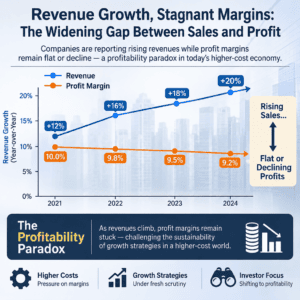 Across industries, companies are reporting rising revenues while their profit margins remain flat or decline, in the gaming world Bally’s are facing this dilema. Often described as a profitability paradox – has become one of the defining challenges of the current business cycle, prompting executives, analysts, and investors to reconsider whether growth strategies built during the pandemic era remain viable in a higher-cost environment.
The Scale of the Problem
Data collected from U.S. companies illustrates the tension. Analysis of year-over-year changes in EBITDA margins from 2024 to 2025 found a median change of roughly zero percent, indicating that most firms have not converted recent revenue gains into meaningful profitability improvements. At the same time, FactSet’s S&P 500 dashboard for the second quarter of 2025 showed blended earnings growth accelerating year-over-year, with net profit margins around 12.3 percent – a level that remains elevated by historical standards. The result is a two-track economy: large-cap firms with pricing power continue to defend margins, while many operators further down the market are absorbing cost increases they cannot pass through.
The pattern is not confined to any single sector. In asset and wealth management, for example, PwC has documented a “profitability paradox” in which revenues rise even as margins fall, driven by persistent cost pressure and fee competition. Similar dynamics are visible in retail, manufacturing, and technology-adjacent services, where pricing constraints limit the ability to offset input inflation.
Why Margins Compress Despite Higher Sales
Analysts generally attribute the phenomenon to three converging forces:
-
Rising costs. Labor, logistics, and input expenses have remained elevated compared with pre-2020 levels, eroding gross margins for firms unable to reprice their offerings.
-
Limited pricing power. Demand sensitivity and competitive pressure prevent many companies from passing higher costs to customers, particularly in commoditized categories.
-
Mix shift. When incremental sales increasingly come from lower-margin products, channels, or customer segments, total revenue grows even as profitability per unit declines.
In addition, strategic priorities set in recent years – aggressive hiring, capital expenditure programs, and investments in digital infrastructure – continue to carry fixed costs that weigh on operating leverage even as top-line growth slows.
The Debate Over Margin Sustainability
There is disagreement about how much of the current margin environment is structural and how much is cyclical. Some economists note that corporate profit margins reached historic highs during the pandemic, aided by broad price increases, and that a partial normalization should be expected. Research published by the Federal Reserve has examined whether post-COVID margins were abnormally high, and found that margin expansion contributed to overall inflation in that period – a dynamic that has drawn scrutiny from policymakers concerned about pass-through pricing.
Others caution that margin compression carries its own risks. Weak margins can pressure firms to restrain wage growth or delay investment, with knock-on effects for the broader economy. For publicly traded companies, persistent divergence between revenue and earnings also tends to compress valuation multiples, as markets increasingly discount top-line growth that does not translate into bottom-line results.
Management Responses
Executives and advisors point to several approaches for closing the gap between revenue and profit:
-
Margin-based forecasting. Shifting planning and incentive structures from revenue targets to contribution margin and unit economics.
-
Pricing discipline. Segmenting customers by price sensitivity and applying targeted increases rather than uniform repricing.
-
Cost structure review. Identifying which recent spending commitments remain aligned with demand and which have become fixed drags on operating leverage.
-
Portfolio rationalization. Reducing or repricing low-margin products and channels that inflate revenue without contributing to earnings.
Outlook
For industry professionals, the central lesson of the current cycle is that revenue growth is not, by itself, a proxy for financial health. Companies that can defend or rebuild margins – through pricing, productivity, and disciplined capital allocation – are positioned to sustain investment and shareholder returns. Those that continue to chase volume without profitability risk finding that their growth increasingly serves only their cost base. The coming quarters will test which firms have made that distinction part of their operating model.