



Kalshi Could Be Pushed Offshore Warns CEO



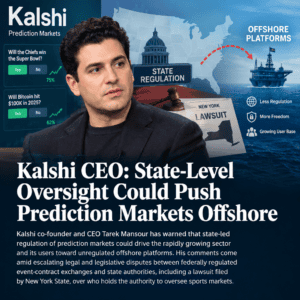 Kalshi co-founder and CEO Tarek Mansour has warned that state-led regulation of prediction markets could drive the rapidly growing sector and its users toward unregulated offshore platforms. His comments come amid escalating legal and legislative disputes between federally regulated event-contract exchanges and state authorities, including a lawsuit filed by New York State, over who holds the authority to oversee sports-related prediction markets.
The Federal-State Conflict
Prediction markets in the United States operate under the oversight of the Commodity Futures Trading Commission (CFTC), which authorizes exchanges such as Kalshi to offer event contracts nationwide. Kalshi, based in New York City and launched in 2021, began offering sports-related contracts in January 2025 and cleared more than $1 billion in trades within the first five months.
State regulators and attorneys general have increasingly challenged this framework, arguing that sports contracts function as gambling and should therefore fall under state gaming laws. Several states, including Missouri and New York, have taken formal action against prediction market operators, while tribal casino interests have also raised objections to the sector’s expansion into their established gaming markets.
Mansour has publicly argued that prediction markets are financial instruments rather than gambling products and that state-by-state oversight would fracture a market designed to operate nationally under a single federal regulator. He has also characterized state crackdowns as counterproductive, contending that they risk pushing traders to offshore platforms that operate without U.S. regulatory protections.
Industry Response and Lobbying Efforts
The dispute has prompted a coordinated industry response. Kalshi, competitor Polymarket, and the Coalition for Prediction Markets – a trade group formed with Crypto.com – have collectively spent at least $3 million on lobbying and related efforts in 2026 to oppose state-level regulation. Mansour has signaled openness to federal safeguards, stating a preference for what he described as more guardrails, while maintaining that oversight should remain at the federal level.
Court rulings have so far offered mixed but sometimes favorable outcomes for the industry. In one notable decision, the Ninth Circuit held in KalshiEX, LLC v. Assad that the company’s federal regulatory status took precedence, reinforcing the argument that CFTC-licensed exchanges may operate nationwide. However, litigation remains ongoing in multiple jurisdictions, and legal analysts note that the tension between federal commodity regulation and state gambling authority remains unresolved.