



Kalshi Secures Partnerships With Four Native American Tribes



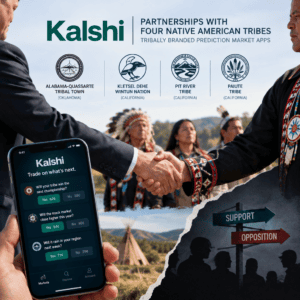 Kalshi has entered into agreements with four Native American tribes to launch tribally branded prediction market applications, a development that underscores a growing rift within Indian Country over how to respond to the rapid expansion of event contracts trading.
The partnerships, announced this week, involve the Alabama-Quassarte Tribal Town in Oklahoma and three California tribes: the Kletsel Dehe Wintun Nation, the Greenville Rancheria, and the Alturas Indian Rancheria. The tribes have introduced prediction apps built on Kalshi’s exchange infrastructure, joining a small but growing group of tribal nations that have chosen to embrace the technology rather than oppose it.
A Break From the Tribal Gaming Establishment
The agreements mark a notable departure from the position held by most of the tribal gaming industry. Tribal nations collectively operate a casino and gaming sector valued at approximately $44 billion to $46 billion annually, and the majority of tribal leadership has treated prediction markets as a direct threat to that economic foundation. Tribes including the Blue Lake Rancheria in California, the Ho-Chunk Nation in Wisconsin, and the Mescalero Apache Tribe, along with several New Mexico pueblos, have pursued litigation against Kalshi, arguing that its sports event contracts constitute Class III gaming under the Indian Gaming Regulatory Act and violate tribal sovereignty and state-tribal compacts.
Kalshi has rejected those characterizations. The company maintains that its event contracts are regulated financial derivatives under the jurisdiction of the Commodity Futures Trading Commission, and it has characterized claims that prediction markets are draining tribal gaming revenue as overstated. Kalshi, valued at roughly $22 billion, has reported weekly trading volumes exceeding $1 billion, with contracts offered across more than 3,500 markets.
For the four partnering tribes, the calculation appears to center on economic opportunity. Several of the participating nations are smaller communities with limited or no existing gaming operations, and Kalshi-powered platforms offer a route into online wagering-adjacent revenue without the capital requirements of a physical casino. Tribal leaders involved in the launches have suggested the partnerships could meaningfully support services and development on their reservations.
Broader Legal and Regulatory Uncertainty
The partnerships arrive amid an unsettled legal landscape. The Ninth Circuit Court of Appeals recently upheld state and tribal regulatory authority over sports-related event contracts, dissolving Kalshi’s preliminary injunction against Nevada gaming regulators. Separately, the Arizona Attorney General has filed criminal charges against the company, and federal legislators have introduced bills targeting prediction markets, citing tribal sovereignty concerns. At the same time, Kalshi has secured favorable rulings in other jurisdictions, and the Commodity Futures Trading Commission has at times defended its classification of event contracts, producing conflicting signals across federal and state courts.
The involvement of the Tunica-Biloxi Tribe of Louisiana, which earlier announced a Kalshi-powered prediction app, suggests additional tribes may follow as the regulatory environment evolves.