



Labor Secures Coalition Support for Gambling Reforms In Australia



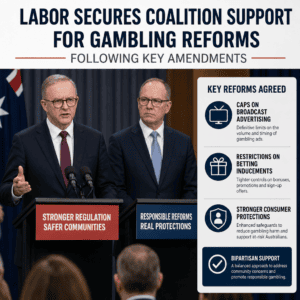 The Albanese government has established a legislative pathway for its gambling reform package, securing essential support from the Coalition after agreeing to a series of targeted amendments. The revised regulatory framework introduces definitive caps on broadcast advertising and tightens restrictions on betting inducements. This legislative development addresses ongoing public policy concerns regarding the visibility of betting services while navigating the operational realities of the wagering, broadcasting, and professional sports sectors.
Under the amended legislation, betting advertisements will be restricted to a maximum of three per hour between 6:00 a.m. and 8:30 p.m. Furthermore, gambling promotions will be strictly prohibited during live sporting broadcasts, within stadiums, and on player uniforms. These measures represent a structural shift in how wagering operators can engage with consumers through traditional media channels.
A central point of the bipartisan negotiation involved financial inducements offered to consumers. The Coalition advocated for enhanced controls over these incentives to mitigate risks for problem gamblers. Discussing the opposition’s approach to the negotiations, Deputy Opposition Leader Jane Hume stated the objective was to “find the balance between what is a legal pastime, but making sure that we protect the most vulnerable.”
Conversely, representatives of the wagering industry have articulated operational concerns regarding the restriction of promotional activities. Kai Cantwell, Chief Executive of Responsible Wagering Australia, has characterized such marketing tools as mechanisms for “product differentiation and customer loyalty,” highlighting the industry’s reliance on tailored promotions to maintain market share.
Acknowledging the complexities of the legislative compromise, Finance Minister Katy Gallagher noted on ABC Radio National that the finalized regulatory parameters were “not where everyone wanted to be.” Nevertheless, she affirmed the government’s broader regulatory agenda, noting the concurrent implementation of “a number of stronger measures around gambling, gambling advertising, and some of the support infrastructure to help with reduce the harm of problem gambling.” Prime Minister Anthony Albanese reinforced this regulatory trajectory, asserting that the forthcoming legislation “will set us up to go into 2027 even stronger.”
The attainment of bipartisan consensus signifies a critical juncture in Australia’s regulation of the wagering sector. As these legislative reforms transition into enforceable mandates, industry stakeholders will be required to adapt to a highly regulated advertising environment. Organizations across the wagering and broadcasting ecosystems must now recalibrate their operational strategies to ensure strict compliance with the updated consumer protection standards.