



Unlicensed Operators Now Capture 72% of Europe’s Online Gambling Revenue



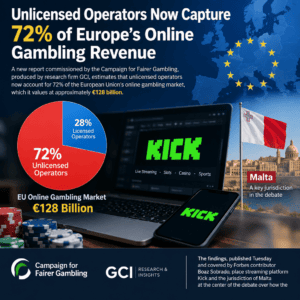 A new report commissioned by the Campaign for Fairer Gambling, produced by research firm GCI, estimates that unlicensed operators now account for 72% of the European Union’s online gambling market, which it values at approximately €128 billion. The findings, published Tuesday and covered by Forbes contributor Boaz Sobrado, place streaming platform Kick and the jurisdiction of Malta at the center of the debate over how the black market has grown to such scale.
A Widening Gap Between Regulation and Reality
The report’s central figure is stark: roughly €92 billion of the EU’s online gambling revenue flows to operators without national licenses, bypassing the regulatory frameworks that member states have built over the past decade. These frameworks were designed to channel players toward licensed, taxed, and supervised operators – a policy objective known as channelization.
The GCI findings align with other recent estimates. Yield Sec research published for the European Casino Association previously calculated that the EU loses around €20 billion annually in tax revenue to illegal online gambling, and separately estimated that as much as 72% of online gambling revenue flows offshore. A study released in early September by Euromat, the European amusement and gaming trade association, put the black market at roughly €12 billion and found it had tripled in size since 2019.
The discrepancy between market-wide totals reflects differing methodologies – including how gross gaming revenue is measured across sports betting, online casino, and emerging crypto-based products – but the direction of travel is consistent across sources.
Streaming, Affiliates, and the Malta Question
Attention has increasingly focused on the promotional ecosystem that feeds unlicensed operators. An investigation by Investigate Europe, published with media partners across 15 countries, documented how influencers on platforms such as YouTube and Twitch direct viewers to unlicensed casinos through affiliate links, in some cases earning commissions of up to 60% of players’ losses. The same investigation traced more than €600 million in payments between 2020 and 2024 linked to a network of websites, many of which appear on national blacklists.
Malta’s role is under renewed scrutiny. As a longstanding hub for online gaming licensing, the island hosts a large share of Europe’s gambling infrastructure. Critics argue that licenses issued under Malta’s framework have at times been used to serve markets where the operator holds no local permission, effectively legitimizing activity that national regulators consider illegal. Malta has defended its licensing regime and points to its own supervisory mechanisms, while the European Commission and several member states have repeatedly clashed with the jurisdiction over the principle that gambling regulation falls primarily to national authorities.
The Policy Dilemma
The data presents European policymakers with a familiar but sharpening dilemma. Stricter advertising restrictions, higher taxation, and tighter affordability controls – often implemented with public health objectives in mind – may in practice push consumers toward operators with no consumer protection obligations at all. Unlicensed sites do not contribute to domestic tax bases, do not participate in national self-exclusion schemes, and generally fall outside the reach of local dispute resolution and responsible gambling measures.
Industry bodies argue that enforcement against the black market should be prioritized, including payment blocking, DNS blocking, and action against affiliates and streamers. Consumer advocates counter that enforcement alone has not reversed the trend and that the appeal of unlicensed products – higher payouts, fewer restrictions, and aggressive marketing – reflects genuine demand-side factors that regulation must also address.